
What the September 2026 Google Spam Update Asks of SEO and Content Teams

What we know so far about the September rollout and a simple plan for reviewing your site.
On September 24, 2026, Google began rolling out its fourth spam update of the year, and Google confirmed the rollout was complete on October 8, 2026, after two weeks of SEO teams watching Google Search Console.
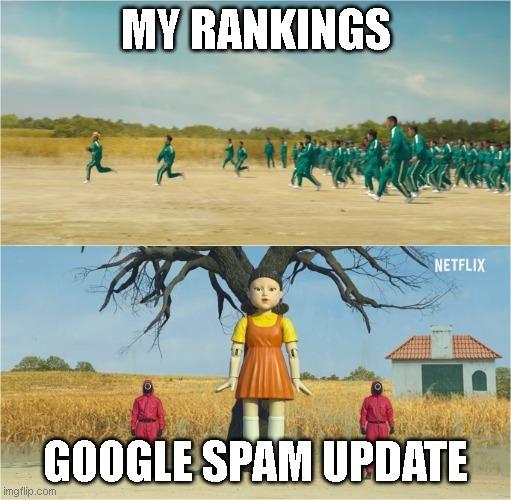
SEOs on LinkedIn have turned the waiting into memes, comics, and jokes about refreshing reports every few minutes. This meme captures a similar feeling, with rankings freezing mid-stride while the update looks on.
I founded Foxxr Digital Marketing in 2008, and our team builds search programs for home service contractors, so I follow every update closely.
Whether you’re a contractor wondering if this update touched your search rankings or part of the team that handles SEO for one, this article walks you through what happened and which pages to check first.
Because Google’s official guidance remains limited, the framework and questions outlined below draw from my analysis of its current spam policies. This article covers the rollout timeline, one compelling theory worth watching, an actionable plan for the coming weeks, and answers to common questions about Google’s spam policies.
The Two-Week Rollout Timeline
Barry Schwartz of Search Engine Roundtable asked John Mueller whether the two-week timeline was a typo, since the three previous spam updates each finished in about two days. Google confirmed that the longer window is intentional.
Schwartz has tracked the volatility in distinct waves. The first wave arrived from September 25 through 27, a second one appeared on September 30, and a third arrived between October 4 and 6. Google confirmed the rollout was complete on October 8. This pattern shows that different categories of sites saw changes in their search rankings on different days, so analyzing a single day’s performance only tells part of the story.
The SAFE Research Paper Theory
Some analysts link this update to a Google Research paper describing SAFE, short for Scaled Abuse Forensic Examiner. The paper outlines a multi-agent system in which a lead investigator assigns tasks to specialized sub-agents. One agent studies hosting and infrastructure signals, another studies visitor behavior, and a third studies content for signs of mass-produced text.
Because the paper comes from Google’s own researchers, it offers a useful look at how the company thinks about abuse at scale. The connection between the paper and this spam update comes from analyst interpretation, and confirmation from Google is pending.
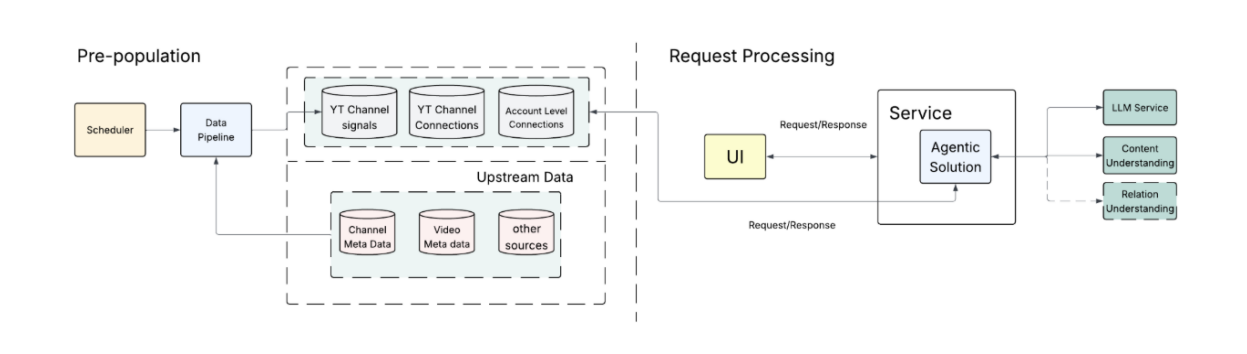
I find the theory useful as a thinking tool because it describes a system that evaluates the intent behind a page.
Programmatic pages are a good example. A site that publishes hundreds of near-identical service pages where only the city name changes may satisfy a basic duplicate content filter, yet each page is thin content that offers readers very little new information. In contrast, pages built around useful, specific details for each location serve visitors and search engines equally well.
Which Pages Are Faring Well
Early practitioner reports describe a split by funnel stage. Top-of-funnel informational blogs are seeing sustained declines, while bottom-of-funnel pages aimed at high-intent visitors tend to see a brief dip followed by a recovery. SEO practitioner EP Kanahara described sites built more than a decade ago whose rankings stayed steady, and credited their focus on visitors who are ready to act.
This pattern fits what service businesses already know about high-quality content. A page that helps a homeowner book a plumber, compare repair options, or understand pricing meets a direct need.
A side-by-side comparison of your service pages and blog posts in Google Search Console will show how these early reports apply to your site.
Some commentators also speculate that the update may target AI-generated commodity content and other low-quality content, which gives teams another reason to review their informational posts.
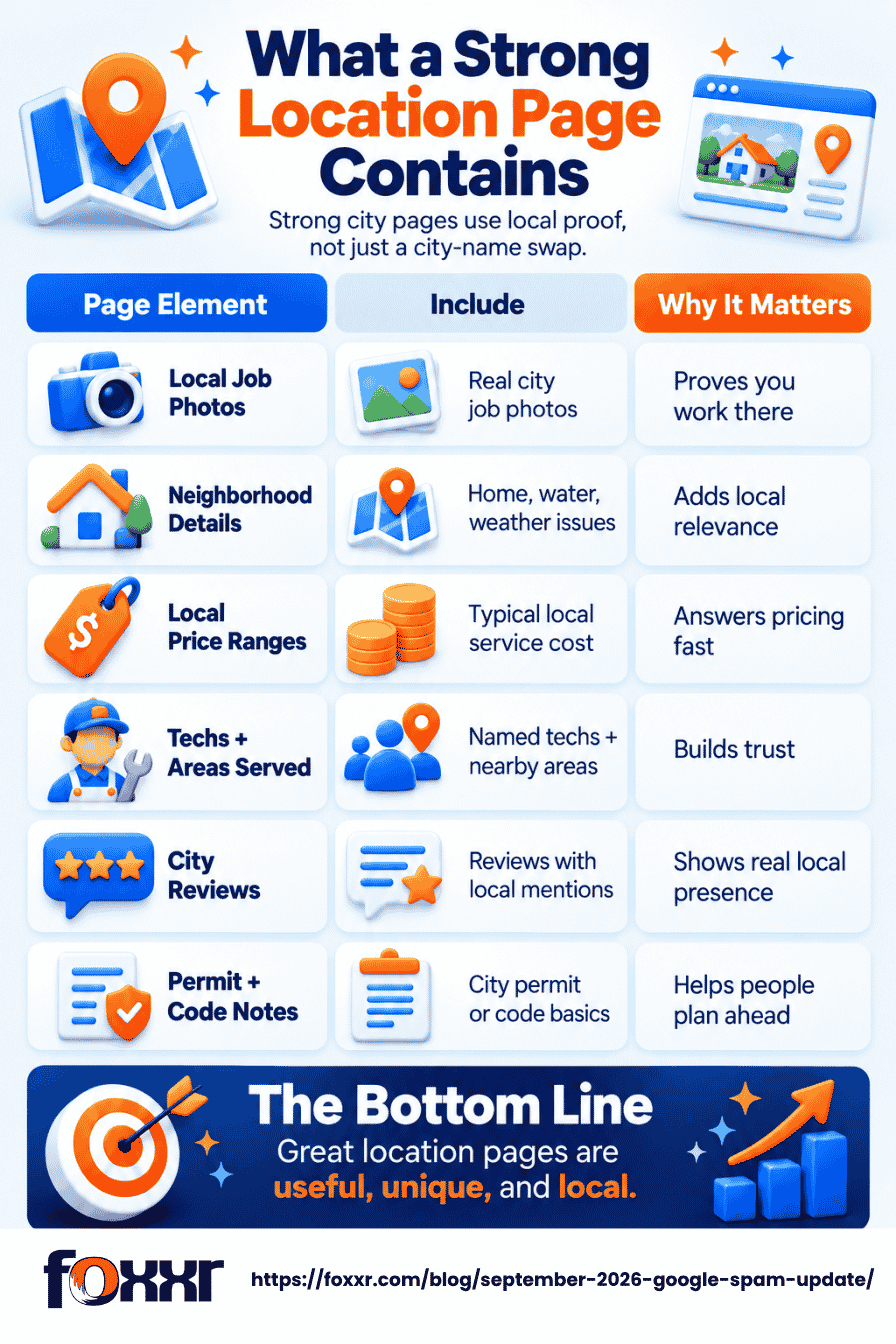
What a Strong Location Page Contains
Home service sites often run dozens of city and service-area pages. When those pages share one template with only the city name swapped, they sit close to what Google’s doorway abuse policy describes. Each location page earns its place by offering details that only that area can supply.
- Photos from local jobs. A water heater install in a specific neighborhood, photographed by your own technicians, shows visitors that your team works there.
- Neighborhood and housing details. Common home ages, hard water, humidity, or storm damage in that city shape which repairs homeowners request, so name them.
- Local price ranges. A typical cost for the most requested service in that city gives visitors a useful answer immediately.
- Named technicians and service areas. Introducing the people who serve that city, along with the neighborhoods they cover, builds trust.
- Reviews from customers in that city. A review that mentions a street or neighborhood confirms your presence in the area.
- Local permit and code details. Many cities have their own requirements for projects such as roofing or electrical work, and explaining them saves visitors a call.
Start with the three cities that bring in the most calls, build those pages out fully, and then work through the rest of your list.
What We’re Studying at Foxxr Digital Marketing
The questions raised by this update connect closely to research our team has underway. Foxxr Digital Marketing is running an ongoing study across home service websites to measure how different content formats perform in AI search environments.
The study looks at AI detection accuracy rates, visibility across tools such as Google AI Overviews, Google AI Mode, and ChatGPT, and the field-data signals that help local contractors maintain their search visibility.
The September update gives that work a timely backdrop. Each wave of volatility adds another data point on which formats earn steady visibility, and I’ll share what we learn as the study progresses.
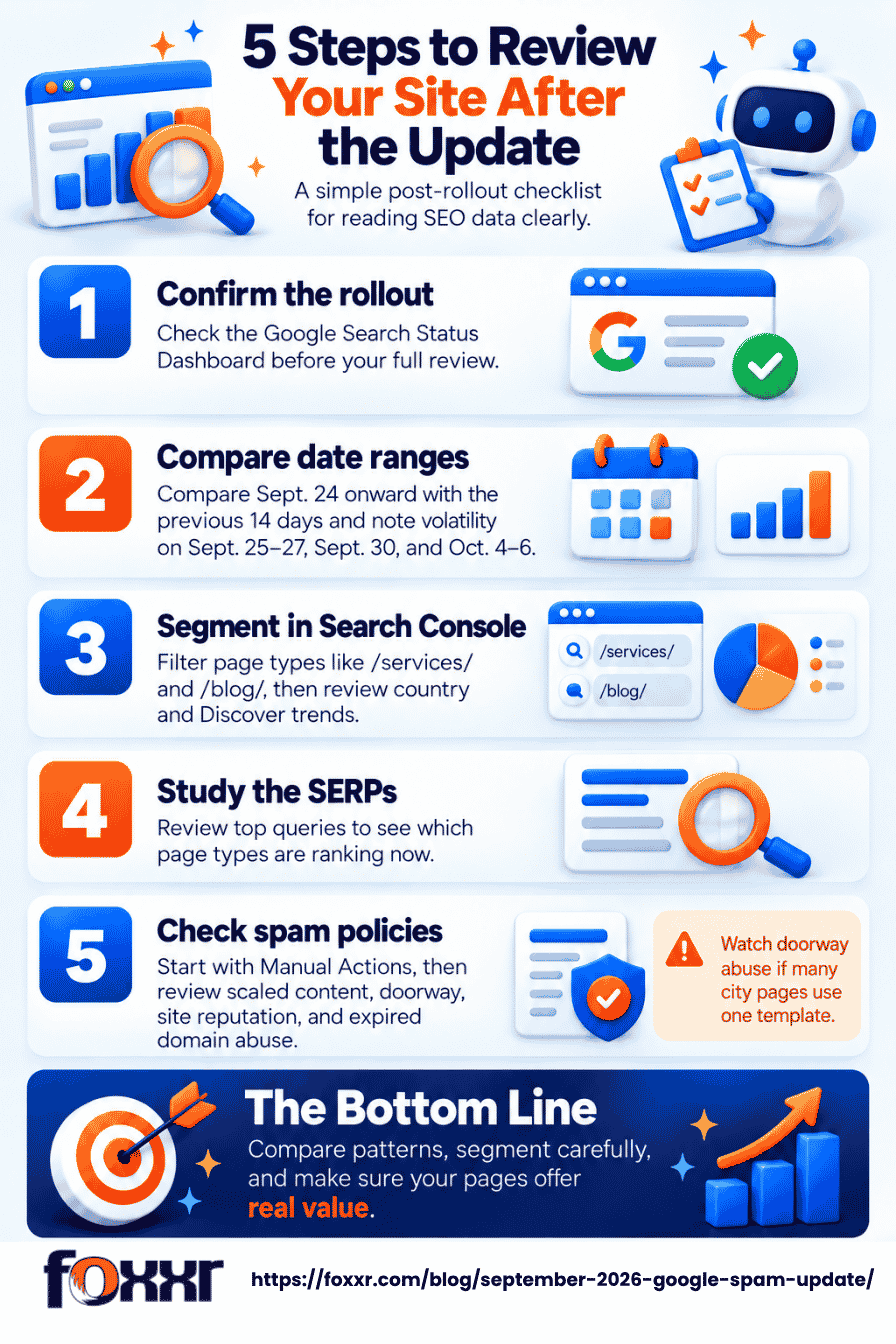
Five Steps to Review Your Site After the Update
Now that the rollout is complete, these five steps will help you read your data accurately:
- Watch the Google Search Status Dashboard. Check it to confirm the update’s status, then start your full review.
- Compare September 24 onward against the previous 14 days. Line up traffic and rankings with the three volatility waves on September 25 through 27, September 30, and October 4 through 6.
- Segment in Google Search Console. Use the page filter with a URL pattern such as /services/ or /blog/ to separate page types, then review country splits and Discover traffic, since some website owners report unusual country traffic during this rollout.
- Study the search engine results pages. Look at the ranking patterns for your most valuable queries to see which page types now appear.
- Match your pages to Google’s spam policies. Open the Manual Actions report first, then review the policies closest to home service sites: scaled content abuse, doorway abuse, the site reputation abuse policy, and expired domain abuse. Doorway abuse deserves a close look if your site has many pages built from one city template.
Content Quality Questions to Ask of Every Page
As you review your site, ask yourself these two questions about each page. Your answers will help you decide where to spend your editing time.
1. Relevance
Does your keyword usage in the title, H1, and opening sentence read naturally to a person?
If a page needs work, start with those three elements. They take the least time to rewrite, and they shape how both visitors and search engines understand the page.

2. Intent
Does the page resolve the visitor’s question right away, or does it exist mainly to capture a click?
Google now uses AI to evaluate content at scale, and the ranking factor that lasts through each update is genuine, human-centric utility. A page delivers that when the first screen on a phone answers the price range or service detail the visitor came for, followed by a next step such as a phone number or quote form.
Frequently Asked Questions
How Is a Spam Update Different From a Core Update?
A core update is a broad change to Google’s core ranking systems that changes how content quality is assessed across the web. A spam update improves SpamBrain, Google’s AI-based spam-prevention system, so it gets better at catching spam content that breaks Google’s spam policies. Both count as algorithm updates, and each one can cause ranking drops for pages that fall short of Google’s standards.
How Often Do Google Algorithm Updates Happen?
Google’s search engine algorithms are constantly evolving, and most of the thousands of changes made to the Google algorithm each year are small enough to go unannounced. Google announces the larger ones, including four spam updates so far in 2026, on the Google Search Status Dashboard. Search Engine Journal reported that the March 2026 spam update finished in about 19.5 hours, while Google’s note for the September update says it applies globally and to all languages. Checking that dashboard and Google Search Console each month is the simplest way to stay informed about each algorithm change.
What Tactics Do Google’s Spam Policies Prohibit?
Google’s spam policies prohibit tactics aimed at manipulating rankings in search results, including keyword stuffing, hidden text, cloaking, link schemes, and publishing low-value pages on other sites to borrow their ranking strength. SpamBrain looks for these patterns at scale, and each spam update improves how Google enforces its existing spam policies. Pages that rely on these tactics may rank lower or drop out of search results.
Do Google’s Spam Policies Apply to AI-Generated Content?
Google’s spam policies apply to AI-generated content when the primary purpose of that content is manipulating search rankings. The scaled content abuse policy covers many pages produced with generative AI tools such as ChatGPT and similar tools, or by any other method, that offer little value to users. AI content that a person reviews, edits, and builds out with original reporting, local detail, and author bios is treated like any other page focused on helping users. Those details also support E-E-A-T, which stands for Experience, Expertise, Authoritativeness, and Trustworthiness.
Do Google’s Spam Policies Cover AI Overviews and AI Mode?
They do. On May 15, 2026, Google updated its spam policies to state that they apply to all of Google Search, including generative AI responses in AI Overviews and AI Mode. Link schemes such as buying or selling links to earn AI citations count as link spam, and showing AI crawlers different content than visitors see counts as cloaking.
How Do I Know If My Site Received a Manual Action?
Open the Manual Actions report in Google Search Console. A manual action comes from a human reviewer at Google, and the report lists the policy involved and the affected web pages. Ranking drops from a spam update are automated and come with no notice, so an empty Manual Actions report points you to your content and links instead.
Does Duplicate Content Break Google’s Spam Policies?
Duplicate content on its own usually leads Google to show one version of the page and filter out the rest. It becomes a spam concern when many pages repeat the same text mainly to rank, such as city pages that only swap the location name. Those pages fall under the doorway abuse and scaled content abuse policies.
Do Core Web Vitals Affect Recovery From a Spam Update?
Core Web Vitals measure loading speed, responsiveness, and visual stability, and a good Largest Contentful Paint score is 2.5 seconds or less. These metrics are among the user experience signals Google’s ranking systems consider, alongside mobile friendliness, and a poor user experience can lower user engagement on any page. Recovery from a spam update comes from fixing the policy issues first. Steps like lazy loading images further down the page help strong Core Web Vitals support a good experience on every device.
How Long Does Recovery From a Google Spam Update Take?
Google says a site can improve once its automated systems learn, over a period of months, that the site follows its spam policies. Ranking benefits that came from spammy links are gone for good once Google discounts those links. After you fix or remove pages, update your XML sitemap so Google can find the changes, and keep working on content quality with up-to-date, relevant content.
Grow Your Google and AI Search Visibility With Foxxr Digital Marketing!
The September update gives SEO and content teams a good reason to look at every page through the eyes of the person searching. Our study of home service websites at Foxxr Digital Marketing continues to add data on which content formats earn steady visibility, and I’ll share what we learn as the results settle.
If you’d like a second set of eyes on your site after this update, our team builds AI SEO and content strategies that help home service contractors earn steady visibility in Google Search, AI Overviews, and AI Mode. Contact Foxxr Digital Marketing to schedule a review of your site and your next steps.